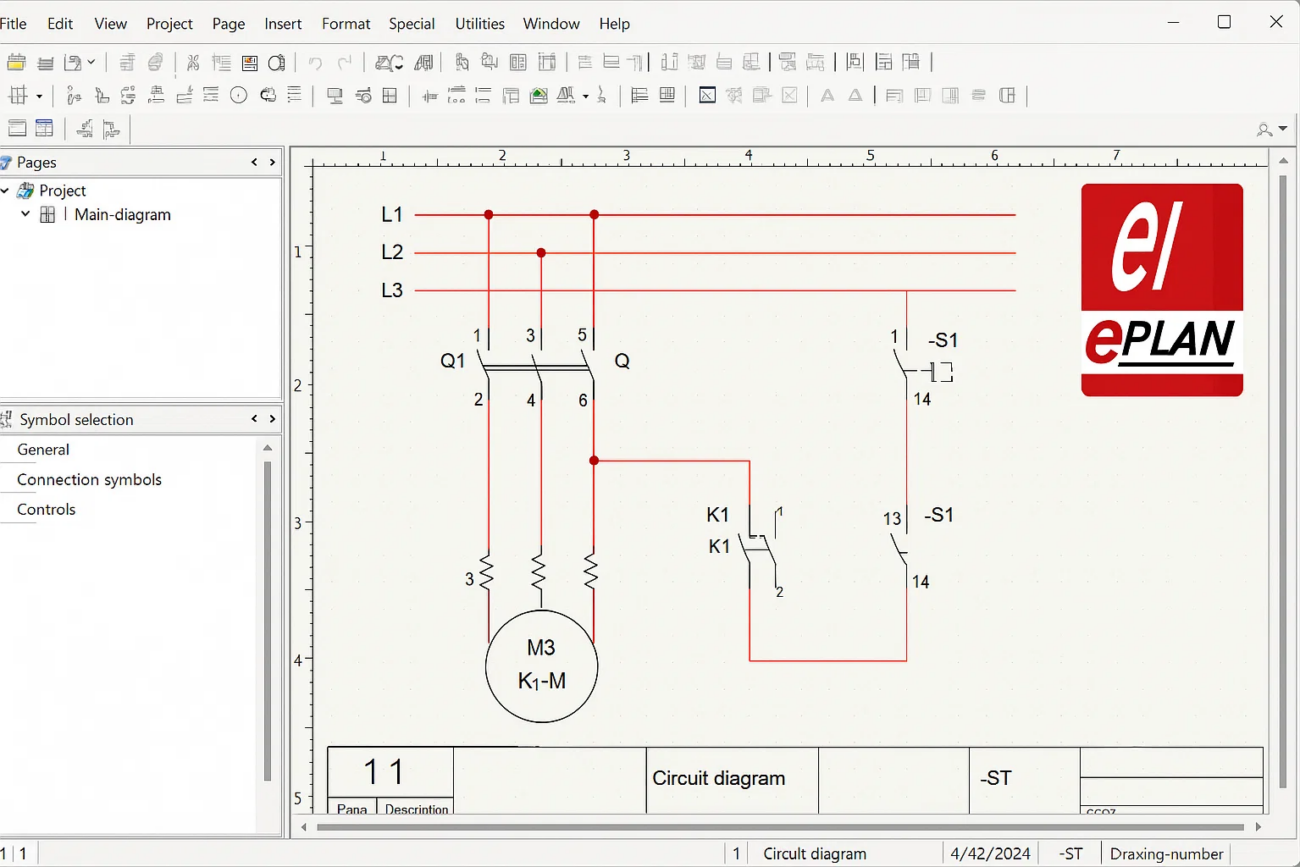
1. Industry background and EPLAN usage status: blind spots in license management under high-frequency electrical design
In the fields of automation equipment, industrial manufacturing, engineering machinery, energy, automobiles and production line integration, EPLAN has become the core tool for electrical design and electrical document standardization. Enterprise engineers use EPLAN daily to complete:
- Schematic design (EPLAN Electric P8)- PLC I/O allocation and logic planning- Control cabinet and electrical circuit design- Electrical component selection and bill of materials (BOM)- Terminal strips, wire numbers, and reports are automatically generated- Multi-project, multi-version electrical document maintenance The actual usage scenarios of EPLAN have several distinctive features:
- Engineers tend to keep EPLAN open throughout the dayElectrical design requires frequent modification, comparison and verification, and engineers rarely close the software repeatedly.2. Project cycle is obviousBefore the plan review, before the drawing node, and before the electrical freeze, the usage will explode.3. Multiple roles share the same authorization poolIncluding electrical design, automation, debugging, process support and other teams.4. Normalization of cross-department and cross-project parallel designLeading to a high degree of overlap in authorized usage. In the absence of monitoring methods, companies commonly encounter:
- EPLAN cannot start, prompting insufficient license- I don’t know who is using it and how long it has been used- There are engineers who run the software but don’t actually design it.- Multiple projects were blocked at the same time during peak periods- Management can only judge whether to purchase more based on experience- The usage status distributed in different factories and branches cannot be viewed uniformly. EPLAN licenses increasingly became a “critical yet opaque” engineering resource.
2. Typical challenges faced by enterprises in EPLAN use and management
1. Technical Frequently Asked Questions
- Floating licenses are often full and engineers cannot open EPLAN in time- It is impossible to check in real time who is currently using it and what type of module is being used.- When an engineer leaves his or her workstation, enters a meeting, or switches to another tool, EPLAN still occupies the license for a long time.- The license is not released due to client exception and background process residue.- Multiple projects produce pictures at the same time, and authorizations are “full” instantly- Usage peaks are unpredictable and you can only wait passively
2. Realistic problems at the management level
- Lack of real usage data, purchasing decisions rely on subjective judgment- It’s not clear which department or project uses it the most- Unable to assess whether existing licenses are truly insufficient- Usage in multiple regions (headquarters/factory/branch) cannot be uniformly counted- Idle and abnormal occupancy cannot be quantified, resulting in hidden waste Essentially, these problems are not EPLAN itself, but the lack of a set of usage visualization and data management mechanisms.
3. How Nodexel intervenes: Build an enterprise-level usage monitoring and management system for EPLAN
Nodexel does not change the authorization method of EPLAN, nor does it interfere with the normal design process of engineers. Instead, it provides a layer of real-time monitoring and data analysis capabilities on top of the existing environment.
1. Real-time monitoring of EPLAN license usage
With Nodexel, businesses can see in real time:
- Users currently using EPLAN- Department/Project- Use start time and cumulative duration- Remaining quantity of authorization pool- Is the current load close to the upper limit?- User is in Active or Idle state For the first time, the usage status of EPLAN is presented in the form of “real-time data”.
2. Identify active and idle (Idle) users
Nodexel automatically recognizes:
- No operation for a long time- Open the software without actually designing- The background hangs but continues to occupy the license Idle sessions will be clearly identified to facilitate managers to determine resource waste.
3. Automatically identify abnormal occupancy and support gentle recycling
For example:
- Software shuts down but license not released- Residual occupation caused by client exception- Long periods of inactivity occupying sessions Under the rules set by the enterprise, long-term idle sessions can be automatically recycled without affecting ongoing electrical design work.
4. Department-level and project-level usage time statistics
Nodexel can output by dimension:
- Usage proportion of different departments- Authorization consumption of each project at different stages- Which projects cause obvious peaks before the node- Is there a situation of long-term high occupancy but low output? For the first time, management can understand the real usage structure of EPLAN based on data.
5. Visual analysis of peak and trough periods
Through historical data and trend analysis, enterprises can clearly see:
- Daily peak hours (such as drawing in the morning and revising in the afternoon)- Usage fluctuations caused by project cycle- Monthly and quarterly authorization pressure changes This allows planning resources in advance rather than reacting to problems after they occur.
6. Support cross-regional and multi-team unified management
Either:
- Headquarters Electrical Design Center- Factory Automation Team- Branch or overseas project team EPLAN usage can be presented uniformly in Nodexel to form a complete view.
4. Direct management benefits brought by data insights
After data transparency, businesses typically see the following improvements:
1. License utilization increased by approximately 20%–40%
By reducing idle and abnormal occupancy, existing authorizations can be used more for real design work.
2. Idle occupancy is significantly reduced
The number of engineers who are “on and not in use” has dropped significantly.
3. Engineers wait less time for permission
The problem of being unable to open EPLAN during peak periods has been significantly alleviated.
4. Authorized procurement decisions are more rational
Whether additional purchases are needed and how much additional purchases are needed are supported by data rather than based on feelings.
5. Improvement of overall project delivery efficiency
Electrical design is no longer frequently interrupted due to resource conflicts, and the project rhythm is more stable.
5. Real usage scenarios of engineers
An automation equipment company, 11 a.m. on Monday. Engineer Xiao Liu was about to open EPLAN to modify the control cabinet schematic diagram, but found the software prompt:
“No Available License” The project is at the drawing point, and the electrical team has repeatedly communicated:
- “Is the debugging team still open?”- “Did anyone forget to turn off the software?”- “Is there another project grabbing resources?” But no one can give a definite answer. After enabling Nodexel, administrators quickly see:
- Two users idle for more than 1 hour- A client exited abnormally but the license was not released- The current peak mainly comes from the centralized drawing of a certain project After releasing the idle occupation, Xiao Liu successfully opened EPLAN and continued the design work, and the project was no longer delayed. This is a very common but long-ignored reality.
6. Summary: Let EPLAN move from “experience management” to “data management”
Nodexel is not a replacement for EPLAN, but a set of engineering software usage management and data support tools.It helps businesses:
- See how EPLAN is actually used- Reduce waste of authorized resources- Optimize resource allocation between departments and projects- Improve the investment-output ratio (ROI) of engineering software- Support enterprises’ transformation to digitalization and refined management When the EPLAN usage environment becomes transparent, analyzable and predictable,The collaboration efficiency and project stability of the electrical design team will naturally improve.
