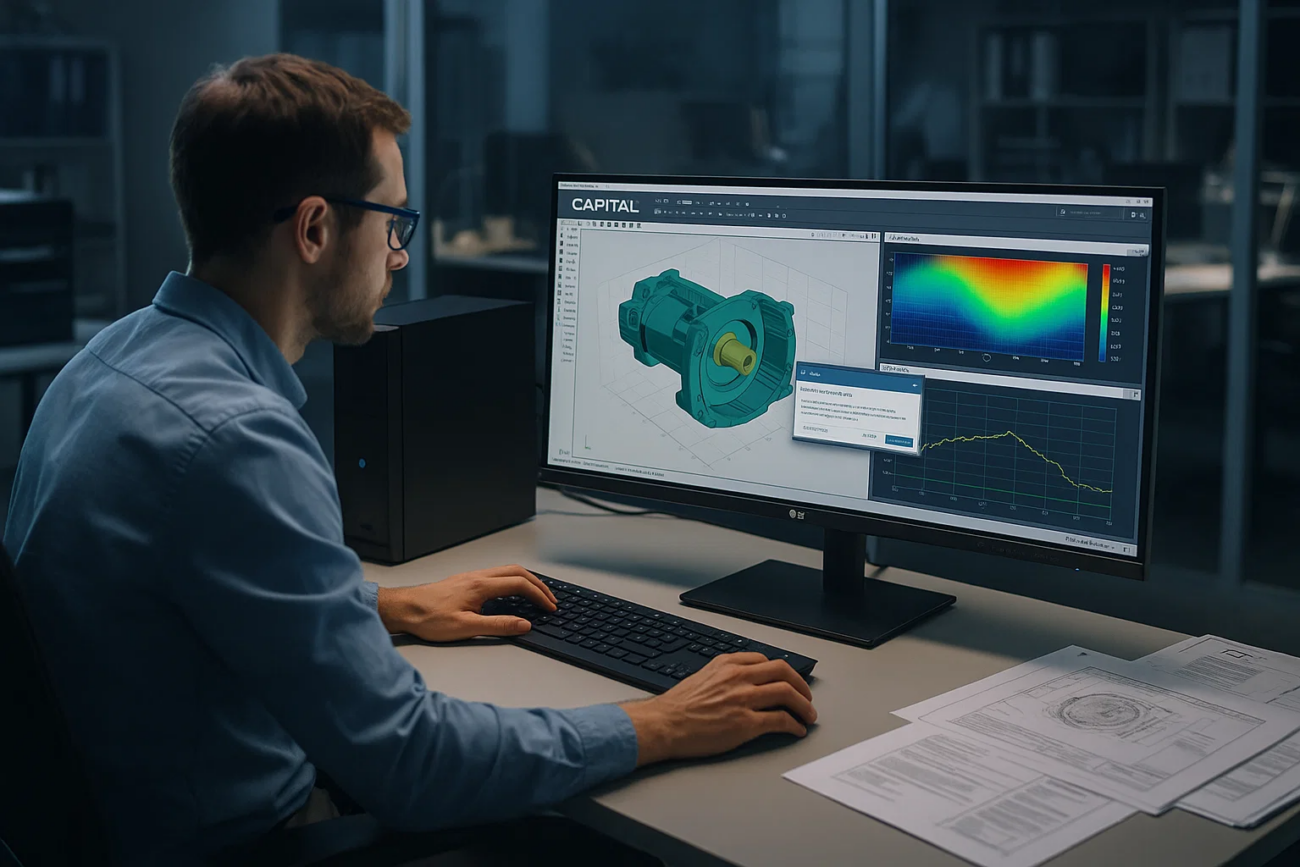
1. Industry background and software usage status: Capital is the core of the electrical design link, but it has been invisible for a long time.
in industries such as automobiles, aerospace, engineering machinery, and new energy,Capital it has become a core tool for electrical system and wiring harness design. Engineering teams often use Capital to:
- Electrical topology design (Wiring Design)
- Harness Design / Formboard
- Electrical system architecture configuration
- Loop analysis and error checking
- Wire harness manufacturing data output
- Design rule verification
- Cross-department electrical collaboration (vehicle electrical, electronic and electrical architecture EE, supply chain, etc.)
The use of Capital has the following distinctive characteristics:
- Engineers typically keep Capital open throughout the day Because the wiring harness is iterated frequently, long-term occupancy permission is required.
- The model is complex and the data is widely related, making it more difficult to shut down the software frequently after it is started. As a result, Idle (no operation) will also continue to occupy the license.
- The periodic outbreak of projects is obvious For example, node freezing, prototype car development, revised design, etc.
- Multiple teams share the same authorization pool Such as EE architecture, wiring harness group, electronic hardware group, factory process group, supplier team.
Without monitoring tools, companies commonly encounter:
- Capital cannot be opened, prompting that the license is full
- I don’t know who is occupying it and how long it has been occupied.
- Some engineering software is opened but not used
- During peak periods, departments “guess and complain” about each other’s resources.
- Management doesn’t know if expansion is needed
- The usage status of teams in multiple locations (headquarters + factory + outsourcing) cannot be observed uniformly
Capital’s authorization management is inherently complex, and existing tools fail to reveal true usage.
2. The pain points faced by enterprises in the use and management of Capital
1. Technical pain points
- The floating license is frequently occupied, especially at peak times at 8 a.m. and 2 p.m.
- Unable to see who specifically occupies the license, making troubleshooting difficult
- Engineers use Capital to do Excel, work, meetings, etc., resulting in long periods of idle time.
- Capital’s background process occasionally does not release the license, causing virtual occupation
- Multiple teams design in parallel (power, body, electronic architecture) → resource chaos
- A short-term outbreak occurred before the project node, resulting in the inability to start the software.
2. Manage pain points
- Lack of real usage data, it is impossible to determine whether expansion is needed
- Occupancy ratios of departments and projects are not transparent, unable to formulate a resource allocation strategy
- Enterprises are unable to assess load trends across different teams
- When multiple places collaborate,The headquarters cannot understand the usage pressure of branches or outsourcing
- Abnormal occupancy and idle occupancy cannot be identified, resulting in a waste of budget
The essential question is: The Capital license is a key resource, but enterprises have long lacked a visual data foundation.
3. How Nodexel intervenes and builds Capital’s refined usage management system
Nodexel does not change the way to obtain Capital or interfere with engineers’ operations, but builds a “real-time, transparent, and quantifiable” monitoring system on top of it.
1. Monitor Capital’s license occupancy status in real time
Includes:
- Online users and departments
- Occupied Capital modules (Wiring, Harness, Formboard, etc.)
- Occupation time
- Number of licenses remaining
- Current load trend (whether it is close to full load)
- User behavior (Active/Idle)
Allowing businesses to instantly see Capital’s true stress situation.
2. Identify idle users and reduce invalid occupation
Nodexel automatically detects:
- No mouse/operation behavior
- Background hang
- Capital is open but the model has not been processed for a long time
Idle sessions are clearly marked, making it easier for management to assess waste.
3. Automatically identify abnormal occupancy and perform gentle recycling
Such as:
- process stuck
- On-hook occupation
- Residual occupancy on weekends
- The user closes the software but the license is not released, etc.
Under the policies set by the enterprise, idle occupation can be automatically recycled (without affecting the normal modeling process).
4. Statistics of usage time by department, project, and region
For example:
- Is the EE architecture team the primary occupant?
- Is there a peak impact on the wiring harness team?
- Is the outsourcing team occupancy exceeding expectations?
- Whether there is competition for resources in a certain model project before the node
The data is presented in chart form to facilitate practical analysis by management.
5. Visually display peak and trough trends
Includes:
- Weekly usage curve
- Explosive trend before node
- The difference between the design stage and the manufacturing stage
- Quarterly/annual resource pressure changes
Businesses can plan resources ahead of time rather than reacting reactively.
6. Support cross-regional and multi-team unified management
Applies to:
- Headquarters R&D Center
- Factory process center
- Overseas R&D Center
- Tier-1/Tier-2 Supply Chain Partnership Team
Get all your Capital usage in one place.
4. Direct benefits brought by data (with quantified results)
Nodexel’s data-based monitoring system can actually bring the following quantifiable benefits:
1. Increase license utilization by 20%–40%
Avoid idle and abnormal occupation, and use resources for real design tasks.
2. Reduce idle occupancy by 30%–60%
The number of engineers forgetting to exit and hanging the software has been significantly reduced.
3. Significant reduction in queue waiting time
The number of Capital startup failures during peak periods has been significantly reduced.
4. Authorized procurement is more accurate
Managers can judge based on historical data:
- Do you want to expand the capacity?
- To what extent can the capacity be expanded?
- Which modules need to be added
- Which modules can remain unchanged
5. Improvement of overall project delivery efficiency
The wiring harness and electrical architecture design process is smoother, reducing construction delays caused by waiting links.
5. Real usage scenarios by engineers
A new energy vehicle company, Monday 10:00.
Engineer Xiao Chen was about to open Capital to view the wiring harness version, but a pop-up appeared:
“No Available License”
The project was reaching the electrical freeze node before the SOP. Xiao Chen anxiously communicated with the EE architecture team and Harness team, but no one could confirm whether anyone was idle.
enable Nodexel after that, IT immediately sees:
- Two clients idle for more than 90 minutes
- An engineer’s Capital background process remains unreleased
- The wiring harness team has just completed the batch wiring import, causing a short-term peak.
- The CFD team occupancy rate is much lower than expected and is not a major bottleneck
The administrator immediately released the Idle occupation, Xiao Chen successfully opened Capital, and the wire harness version review progressed as scheduled.
This scenario is very common and is a typical case of “invisible problems becoming visible” in daily business life.
6. Summary: The transparent use of Capital is an important step to improve the efficiency of electrical design.
The value of Nodexel cannot be exaggerated. It is essentially a set of “basic data monitoring and management tools” that help enterprises:
- See the real usage of Capital
- Reduce resource waste
- Avoid project delays
- Make procurement budget more scientific
- Make electrical design links smoother and more predictable
- Improve Capital’s return on investment (ROI) within the enterprise
Once Capital’s usage behavior and payload become transparent, enterprises’ management efficiency of electrical design resources will be truly improved. Collaboration processes and project delivery will also be more stable.
