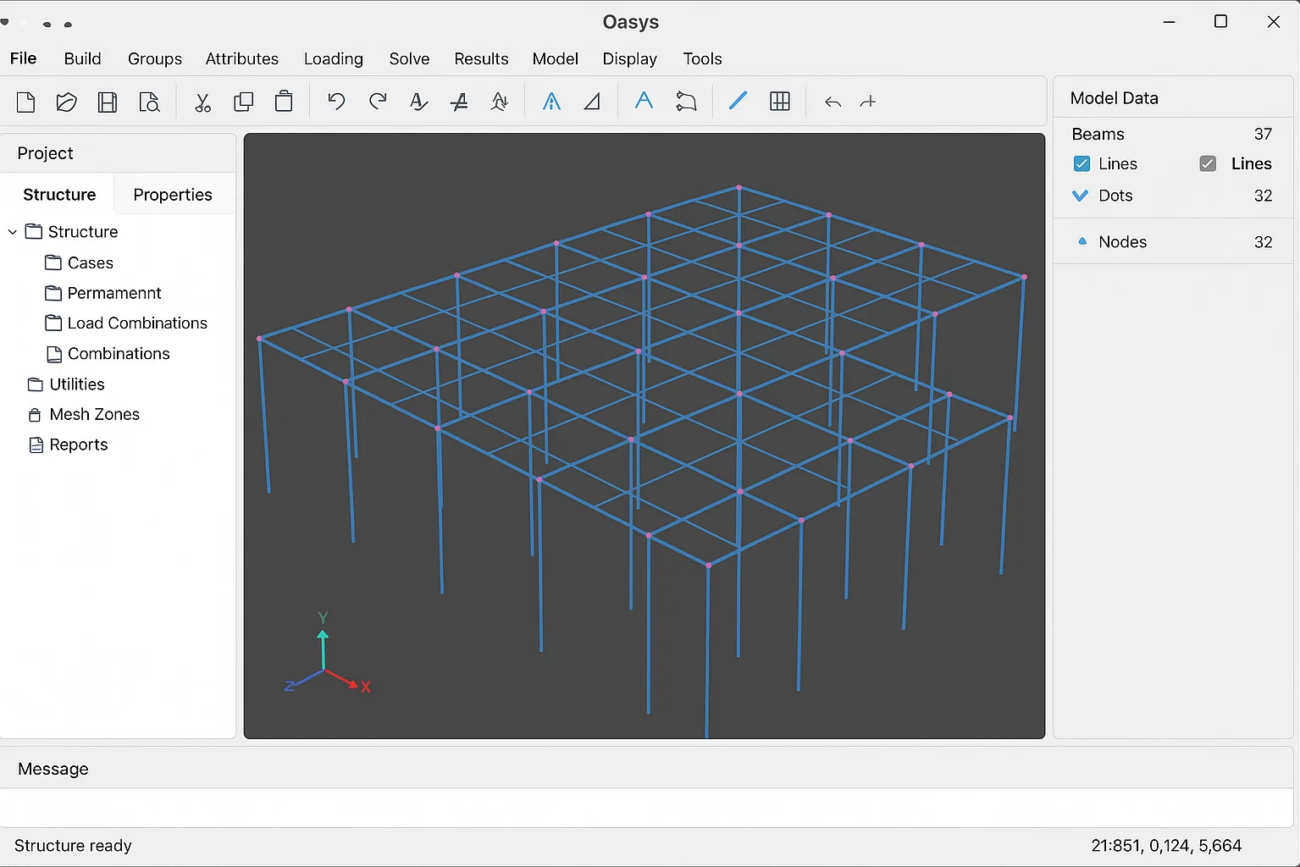
1. Industry background and current usage of Oasys: Engineering calculations are highly centralized, but usage transparency has long been lacking
In the fields of civil engineering, building structures, rail transit, bridges and tunnels, disaster prevention projects, and large industrial structure design, Oasys software (such as GSA, PDisp, Slope, AdSec, etc.) is widely used for:
- Overall structural analysis and finite element calculation- Complex working condition combination and nonlinear analysis- Foundation, Slope and Stability Analysis- Component design verification and specification verification- Scheme comparison and multiple rounds of structural optimization- Project phase review and calculation review In actual engineering environments, the use of Oasys shows obvious characteristics:
- Heavy computing tasks and long running timeLarge structural models often require long calculation times, and engineers continue to occupy licenses.2. Concentrated use during the planning phaseDuring the preliminary design, expanded design, and review stages, multiple engineers start analysis tasks at the same time.3. Engineers are used to “working with software on”Oasys is often left open as a background tool to view results or adjust models at any time.4. Multi-project parallelConsulting companies or design institutes usually advance multiple projects at the same time and share the same authorization pool. In the absence of effective monitoring, companies often encounter the following problems:
- Oasys cannot start, prompting insufficient license- It is unclear who is currently using it and how long it has been occupied- An engineer has not operated for a long time, but the license is still occupied.- The client did not release the license normally after the calculation was completed.- Resource conflicts during project peak periods affect analysis progress- Management cannot tell whether delegation is truly insufficient- The usage status of branches and project teams cannot be uniformly grasped As a key engineering calculation tool, Oasys’ license has gradually become a “high-value but invisible” resource.
2. Typical challenges faced by enterprises in the use and management of Oasys
1. Technical pain points
- Floating licenses are often full and engineers cannot start calculations in time- Unable to view current Oasys users and modules in real time- The engineer runs the software but does not perform calculations, causing Idle occupation.- After a long calculation, the process remains and the license is not released.- Multiple projects submit calculations at the same time, causing a short-term resource squeeze- The computing peak is unpredictable and you can only wait passively.
2. Pain points at the management level
- Lack of real, quantifiable usage data– It is impossible to distinguish which projects and which teams are the main resource consumers- Whether an expansion license is needed can only be determined based on experience.- Project node resources are tight, but the reasons are difficult to review- Distributed team (headquarters/branch/project site) usage environment fragmentation- Waste caused by idleness and abnormal occupancy cannot be identified These problems are not problems with the Oasys software itself, but rather with the company’s lack of management and data support systems for the use of engineering software.
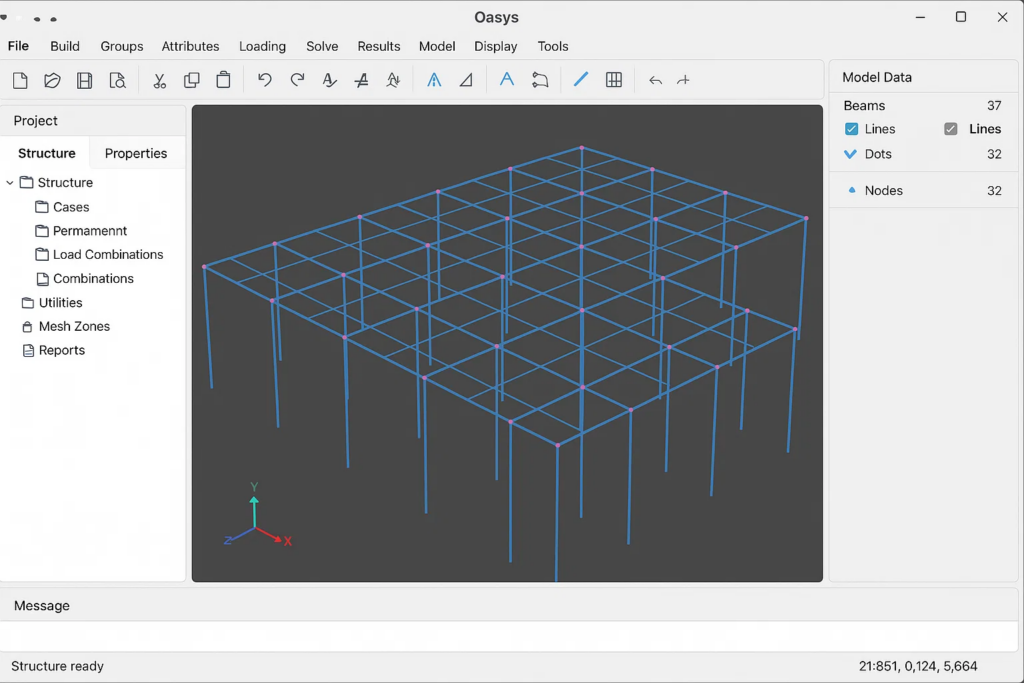
3. Nodexel’s intervention: building Oasys’ enterprise-level usage monitoring and management capabilities
Nodexel does not change the authorization method of Oasys, nor does it affect the normal analysis process of engineers, but adds a layer of “real-time monitoring + data analysis” management capabilities to the existing environment.
1. Real-time monitoring of Oasys license usage
With Nodexel, businesses can see in real time:
- Engineers currently using Oasys- Department or project team- Occupied Oasys modules- Use start time and cumulative duration- Remaining quantity of authorization pool- Is the current load close to the upper limit?- Usage status (Active/Idle) For the first time, the usage status of Oasys changed from “invisible” to “real-time visible”.
2. Identify active and idle (Idle) users
Nodexel automatically recognizes:
- Long inactive sessions- Situation where the interface is only opened but no calculations are run- The engineer leaves the workstation but keeps the software open Idle sessions are clearly marked to provide a basis for subsequent management.
3. Automatically identify abnormal occupancy and support gentle recycling
like:
- Did not exit the software after the calculation was completed- Client exception causes license not to be released- Invalid session hanging for a long time Under the policies set by the enterprise, long-term idle occupancy can be automatically recycled without affecting normal computing tasks.
4. Department-level and project-level usage time statistics
Nodexel supports analyzing Oasys usage from multiple dimensions, such as:
- Which projects take the longest- Which teams are most heavily used during peak periods- Are there a small number of projects that occupy a large amount of resources for a long time?- Distribution of idle occupancy among different departments Help management understand resource structure using data rather than feelings.
5. Visualization of usage trends during peak and trough periods
Through historical data analysis, companies can clearly see:
- Peak usage within the day- Usage fluctuations caused by project stages- Monthly and quarterly authorization pressure changes This allows you to plan resources ahead of time rather than reacting to project delays.
6. Support cross-regional and multi-team unified management
Either:
- Headquarters design team- Branch or regional design center- Project site engineering team All Oasys usage can be presented uniformly in Nodexel to form a complete view.
4. Direct management benefits brought by data insights
After using data transparency, companies typically experience the following quantifiable improvements:
- License utilization increased by approximately 20%–40%– Idle occupation is significantly reduced, and invalid resources are released- Engineers wait time for licenses significantly reduced– Authorized purchasing is more rational and avoids blind additional purchases- Project analysis rhythm is more stable, reducing delays caused by resource conflicts These benefits do not come from increasing the number of licenses, but from the proper management of existing resources.
5. Real usage scenarios of engineers
Structure office of a design institute, 10 a.m. on Wednesday. Engineer Xiao Zhang was about to open Oasys GSA to review the structural model, but found the software prompt:
“No Available License” The project is at the review stage, and the structure team has repeatedly asked:
- “Is there another project running a large model?”- “Did anyone forget to turn off the software?”- “Is there someone occupying the backstage?” But there are no tools for quick confirmation. After enabling Nodexel, administrators immediately see:
- Two sessions idle for more than 1 hour- A computation ended the night before, but the client did not release the license- That morning was the peak period for centralized review of multiple projects. After releasing the idle occupation, Xiao Zhang successfully started Oasys and completed the review work, and the project progress was no longer delayed. This is a very common real-life scenario among engineering teams that has long lacked solutions.
6. Summary: Let Oasys move from “experience use” to “data management”
Nodexel does not change Oasys’ engineering capabilities, but provides it with a set of infrastructure that uses transparent and data-based management to help companies:
- See Oasys in action- Reduce license resource waste- Optimize resource allocation between projects and teams- Improving Return on Investment (ROI) of Engineering Calculation Software- Support digital upgrade of enterprise engineering management When the Oasys usage environment becomes transparent, analyzable, and predictable,The collaboration efficiency of the engineering team and the stability of project delivery will also be improved.
